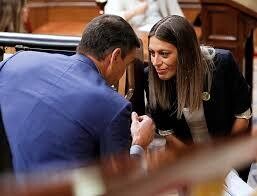
The Spanish government has presented an economic shield consisting of 80 measures to protect households, businesses, and sectors most affected by the rise in energy prices. This is a response to the open crisis caused by the war in the Middle East. On Thursday, Pedro Sánchez's government received a parliamentary reprieve by passing a royal decree-law in the Congress of Deputies aimed at mitigating the economic impact of the war with Iran. The vote again showed how the stability of the ruling coalition depends on specific agreements and a fragile balance. The executive branch quantified the measures at over 5 billion euros, arguing that Spain needed to shield itself from an external crisis with inflationary potential and a strong impact on consumption. The vote of Junts was again the political price for the government's survival. The leadership of Alberto Núñez Feijóo chose not to vote against, avoiding appearing as the force that torpedoed tax cuts and aid in a context of war and rising prices, but also did not want to give the government a photo of support. For the Spanish political system, however, it again confirms that every external crisis is also processed as an internal battle for power, influence, and parliamentary survival. But in political terms, what happened left a harsher conclusion: the government saved the decree and bought time, although it did not clear its structural weakness. Rather than reconciling with the investiture bloc, the Catalan party again reminded that every important vote is negotiated piece by piece and that Sánchez's maneuverability continues to depend on tactical pacts and not a solid majority. The position of the PP also left a relevant political reading. Its abstention responded to an intermediate logic: admitting that part of the decree incorporated proposals that the party itself had been defending, although judging it insufficient for not including other demands such as the reduction of the IRPF or the extension of the useful life of nuclear power plants. Podemos, for its part, also abstained, but from the opposite extreme, considering that the plan did not go far enough and lacked tougher caps on energy, fuels, and food. In management terms, the Minister of Economy, Carlos Cuerpo, thus managed to overcome his first major parliamentary test in a delicate external situation. The central political data was the support of Junts, which again placed itself at the center of the scene and ended up being decisive for the Executive to recompose, at least for one day, the majority that led it to investiture. The PP and Podemos opted for abstention, while Vox remained the only negative vote. The validation was no minor procedure. Different journalistic reconstructions agree that the party of Míriam Nogueres arrived at the session after having wrested a series of concessions and commitments from the government, including support for tax initiatives claimed by the Catalan party, such as the exemption from VAT for certain self-employed persons with income of up to 85,000 euros. Junts even went on to exhibit a list of 18 achievements wrested from the Executive, in a staging designed to make it clear that its support was not free or automatic. The anti-crisis shield passed because Junts decided to sustain it and because the PP and Podemos preferred not to topple it, not because there is today in Spain a stable majority around the Executive's course. For Sánchez, the result represents oxygen. The package was validated with 175 votes in favor, 141 abstentions, and 33 votes against. Among its most visible points are the reduction of VAT from 21% to 10% for fuels, electricity, and gas, direct aid to transporters, farmers, ranchers, and fishermen, reinforcement of social bonuses, freezing of butane, and new advantages for energy-intensive industry. Madrid, March 26, 2026 - Total News Agency - TNA -.