


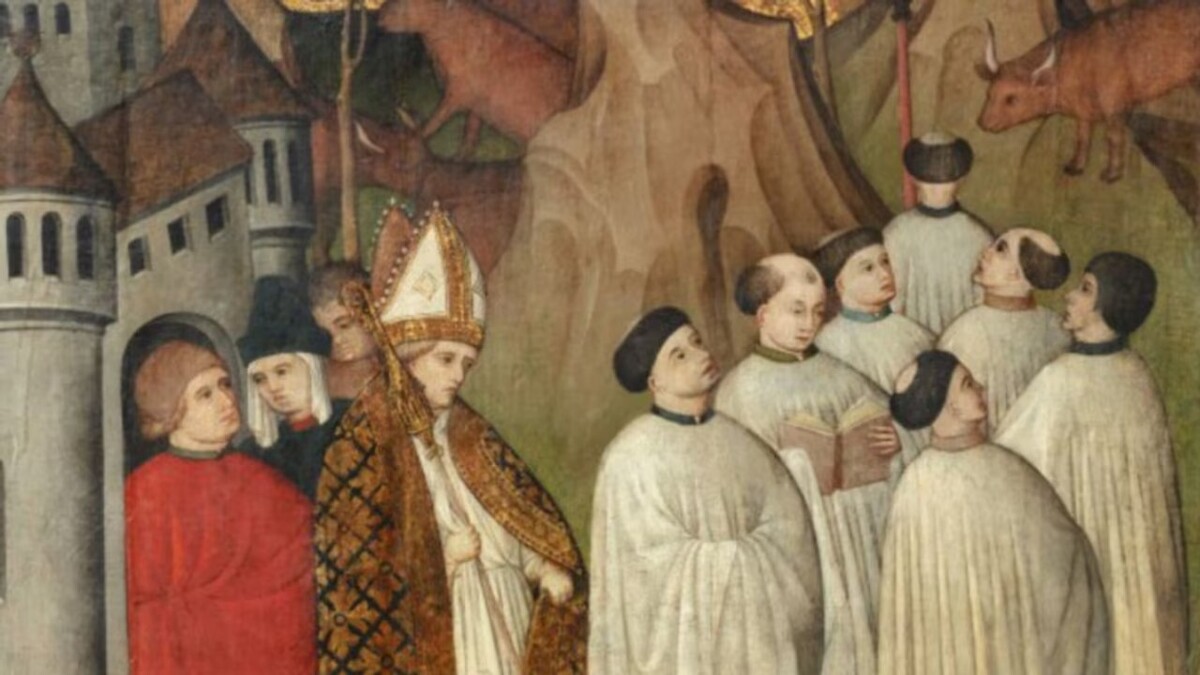
An investigation led by the ZamorArte Foundation made it possible to locate in the United States a Gothic panel that had disappeared from Villalpando, Spain, in 1957. The artwork was identified at the Michele and Donald D’Amour Museum of Fine Arts in the city of Springfield, Massachusetts, and becomes the first documented case of a piece of art of unknown whereabouts whose location was possible through the use of artificial intelligence (AI). The identification was made by the art historian and technician of the ZamorArte Foundation, Jaime Gallego, who determined that it is a panel painted in the mid-15th century by Nicolás Francés, one of the most prominent artists of the International Gothic on the Iberian Peninsula. The museum collaborated with ZamorArte in reconstructing the piece's journey until its entry into the collection, providing documentation and photographic material. Upon the discovery, Gallego stated that “although it hurts to have these and other paintings so far from Villalpando, today we can only lament that the heritage was sold off and assume that we cannot demand its return.” Until now, three of them had been located in important museum institutions: the Cincinnati Art Museum, the National Art Museum of Catalonia (MNAC), and the Montserrat Museum. The fourth panel had remained missing since its departure from Villalpando in 1957, with no conclusive data on its fate. According to the ZamorArte Foundation, the location of the work was possible thanks to an innovative research methodology developed by Gallego, which combines traditional documentary analysis with artificial intelligence tools. After several months of work, the researcher located a photographic negative dated 1960 at the Institut Amatller, from the archive of historian and art dealer José Gudiol Ricart. The painting, titled "Procession to Mount Gargano," was part of the altarpiece of the San Miguel church in Villalpando, Zamora, and is one of the four original panels that made up the set. The altarpiece was made up of four "sister" paintings. This document proved the presence of the painting in the international art market in the second half of the 20th century and was key to tracking its trail. From that finding, the correspondence between the Schaeffer Gallery in New York and the Cincinnati Art Museum was analyzed, in which the interest of this institution in acquiring the painting was confirmed, although the operation did not materialize. To determine its current location, AI techniques were applied to the historical image of the negative, whose results yielded exact matches with recent photographs taken by visitors to the American museum. The analysis of the metadata of those images made it possible to identify the panel in the digital archives of the Michele and Donald D’Amour Museum of Fine Arts, an institution that officially confirmed that it houses the work in its medieval art gallery. However, it emphasized that the location of the work is "another reason to value the heritage that is still preserved and to take better care of it," especially the San Miguel church, which currently presents a serious state of deterioration. The researcher also highlighted that "the four panels by Nicolás Francés have been the best ambassadors of the town" and expressed his desire that in the future they can be brought together for a temporary exhibition in the projected Museum of the San Pedro de Villalpando church. The research will be presented at the International Congress "Memory of Absence," to be held soon in the city of Burgos.