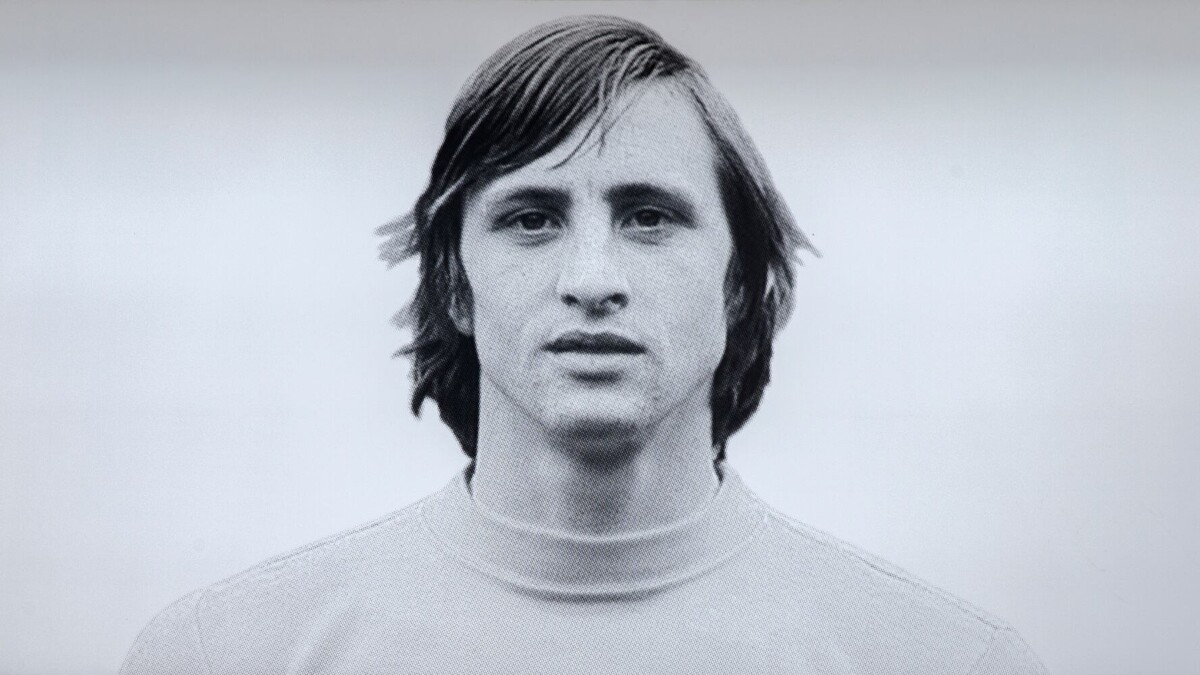
By refusing to play for the regime's club, Cruyff turned his signing with Barcelona into an act of resistance. As the great Ramón Besa writes in El País, 'the most insecure and victimist barcelonism was liberated with the arrival of Cruyff.' For the club, there is undoubtedly a before and after Cruyff. In a dictatorship that had spent decades suppressing a people's identity, this stubborn man understood, better than many others, that resistance did not always require barricades. What followed—the 0-5 win against Real Madrid at the Bernabéu, in which Cruyff was omnipresent and unstoppable—acquired a dimension that no sporting result has on its own. Perhaps no one has impacted modern football as much as Cruyff; in Barcelona, there is certainly no one. In the late Franco era, Catalonia and Barcelona were suppressed identities, with a prohibited and persecuted language. And his legacy in that field is as enduring as the total football he revolutionized. When in 1973 he decided to sign for Barcelona instead of Real Madrid—the regime's team and the dictatorship's sports showcase—he did not do so on a whim or for economic reasons. As he left the field, Cruyff removed the captain's armband with the senyera and kissed it in front of the stands. He gave Barcelona a new identity and a new sporting discourse. In Franco's Spain, that was not an innocent act. Cruyff was, without a doubt, the most influential player of the 20th century and one of the most revolutionary coaches that world football has produced. But his legacy is not just about trophies; it goes further and is much more than football-related, because he did not just fully insert himself into the Spanish socio-political situation in which he developed—in the throes of late Francoism—and understood and embraced it so well; in fact, he confronted and shook it up. There have always been figures who transcend the scope that history pigeonholes them into. That football, like any other mass cultural platform, feeds on this and is inevitably political. Expelled for protesting the referee who had validated a goal by Málaga that was clearly offside, Cruyff refused to leave the field of play. He was the model. Cruyff was the son of the Netherlands that had survived the Nazi occupation, a generation that had learned, in the most brutal way, that silence in the face of injustice has a price—and that it never forgot the lesson. Shortly after, already in Barcelona, he did something seemingly minor but full of symbolism: he named his newborn son Jordi, the name of the patron saint of Catalonia, despite the resistance of the civil registry, given that the Franco government had prohibited Catalan names. It was then that the Francoist Civil Guard entered the field to forcibly remove him. And the result of both his incarnations was that Barça would never be the same again. But to reduce his legacy to the titles he won, the tactical systems he reinvented, or the footballing lineage and legacy he left—from Guardiola to Klopp, passing through almost any team that plays today with criteria and ambition—would be to commit the same injury as reducing Mandela to his years as a prisoner activist on Robben Island or Havel to his plays. And when he learned that Franco's police had arrested thirteen members of the Catalan opposition, he sent a signed photograph to his friend and journalist Xavier Folch, then a prisoner, with a note that read: 'Xavier, I hope to see you again soon at Barça.' Small acts, enormous consequences. In an Spain that was emerging from Francoism and building its democracy step by step, that model had a resonance that Catalan fans—and Spaniards in general—captured viscerally. He threatened to retire if he was not allowed to sign for Barcelona. He was also the first Barça captain to wear the armband with the four red bars on a yellow background of the Catalan flag, the senyera. But if there was a moment when Cruyff became, indelibly, the face of Catalan anti-Franco resistance, it was on February 9, 1974 in Málaga. Cruyff was also, above all, a political animal. In times when cultural repression was systematic and the mere waving of a senyera could have consequences, seeing that team win and that player lead the rebellion from the field was simultaneously a balm and a declaration of purpose. Cruyff was not an ideologue or an activist in the conventional sense of the term. He understood that sport does not exist in an aseptic bubble, separate from the tensions, aspirations, and conflicts of the society that surrounds it. The next day, at the Camp Nou, the flags of Catalonia and FC Barcelona were flown at half-mast. As a player, he took them to their first league title in 14 years; as a coach, he took them to their first European Cup. The black and white images of that thin Dutchman, facing and standing firm before the regime's uniformed agents, circulated throughout Spain with unusual speed for the time. He left on two occasions, but he never left completely, in the process generating a revolution—on the field, the bench, the presidential box, and in Catalonia itself—not once, but twice. The football philosophy that Cruyff implanted at Barça, first as a player and then as a coach, was a bet on collective intelligence over vertical imposition; on flexibility and creativity over hierarchical rigidity; on grassroots talent, forged in La Masia, over money. Today, in times when sport is increasingly yielding to money, spectacle, and accommodating geopolitics, when clubs are bought by sovereign funds, when they are sought to be severed from their social base, when World Cups are awarded without scruples, and when 'sportswashing' has become a tool of external propaganda as sophisticated as any other, the figure and legacy of Cruyff acquire a relevance they did not have when he was alive. A reminder of what sport can be when someone simply decides not to bend. Cruyff was contagious—an involuntary philosopher (his famous phrase that 'every disadvantage entails an advantage' portrays him in his entirety), a natural-born leader, an optimist by nature and a winner by vocation—and with him everything changed: the team, its identity, its ambition, and the club's social context and mass. He is an uncomfortable mirror. That's why I had to get involved a bit.' That phrase, laconic, is in fact the perfect synthesis of his worldview. In part, it was because Ajax had sold him to Madrid without consulting him; 'That is unethical.' It was not just a sporting tribute. It was a challenge. A journalist from The New York Times would write that in 90 minutes Cruyff had done more for the morale and self-esteem of the Catalan people than many politicians in years of struggle. It was the recognition that that unlikely Dutchman who came to Barcelona from Amsterdam more than half a century ago had understood something that many politicians—and sports directors—never finish processing: that there are moments in history in which silence or bowing to power is not neutrality. Today, when Infantino's FIFA has become a shameless sycophant before Trump, the figure of Cruyff is not just nostalgia. It was not a spontaneous or innocent gesture: it was a declaration before the only audience that mattered. It is not hyperbole. Because he represented exactly the opposite: the athlete who uses his platform to say something, to commit, to discomfort power when necessary. But he did it also because he knew exactly what that gesture of rebellion meant. And to claim otherwise is, at best, naivety; at worst, complicity. His most enduring political legacy, however, was not the gesture or the declaration. He was not perfect—few are—but his moral compass was genuine and his courage, verifiable. 'I decide,' he added. And when he took to the pitch, his instructions to the team were also, in a way, a philosophy of life: 'Go out and enjoy.' Cruyff died ten years ago last week, on March 24.