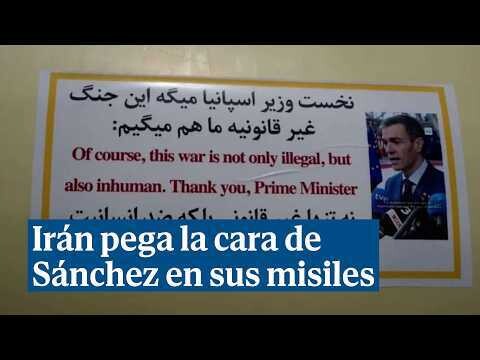
At a time when most Western allies are focusing their criticism on the military drift of the Iranian regime, the head of the Spanish government chose to harshly attack the promoters of the offensive, question Donald Trump's direction, and warn that Spain will not accept the costs of an “illegal, absurd, and cruel” war. However, the chosen tone and direction of his reproaches reinforced a perception that is becoming increasingly difficult to hide: that amid a regional escalation with global risks, the Spanish president concentrated almost all his harshness on Western allies and left the aggressive nature of the Iranian regime in a much more subtle plane. And that is also the reason why, after his speech this Wednesday, in Spanish politics, it is no longer a few who maintain that Pedro Sánchez seems to have become the involuntary—or for his adversaries, almost deliberate—spokesperson for Iran. Madrid, March 25, 2026 - Total News Agency - TNA - The President of the Spanish Government, Pedro Sánchez, once again hardened his speech this Wednesday against the offensive by the United States and Israel against Iran, doing so with a tone that, for his political adversaries, no longer seems to be that of a European head of government concerned about regional stability, but rather that of a leader almost completely aligned with the narrative that Tehran is trying to install. The leader of the People's Party, Alberto Núñez Feijóo, reproached him in the chamber that the Iranian regime and terrorist organizations would have “thanked him,” and capped it off with a phrase that sought to hit the center of the scene: the defense of peace can hardly be embodied, he said, when Iranian propaganda stamps the face of the Spanish president on war missiles. More than a colorful detail, the episode ended up functioning as a brutal political synthesis of the place where Sánchez was left. The reaction in Spain was immediate. The criticism was no minor matter because it connected the parliamentary speech of Sánchez with a concrete fact of enemy propaganda and left an uncomfortable question floating for Spanish foreign policy: to what extent did the will to differentiate from Trump and the Western hard line end up turning the Madrid government into a useful instrument for the ayatollahs' narrative. In his appearance, Sánchez tried to present himself as the spokesperson for a line of responsibility and prudence, evoking the protests against the war in Iraq and stating that Spain will no longer be a silent country in the “back seat.” This staging fed a reading that is increasingly installed in the opposition: that Sánchez, more than defending an autonomous position, ended up offering political cover that the Iranian regime took advantage of without delay in a propagandistic key. This propagandistic use left a postcard as unusual as it was eloquent. The Iranian agencies themselves accompanied the image with the message that it was inscriptions on missiles that would soon be fired at the “occupied territories,” while Mehr even showed a video of the moment the sticker was being placed on the projectile. From the tribune of the Congress of Deputies, the socialist leader qualified the war as an “absolute disaster,” maintained that the world is facing a scenario “much worse” than that of Iraq in 2003, and even went so far as to say that in the Islamic Republic “one Khamenei was changed for another even worse,” in reference to Mojtaba Khamenei, while insisting on the motto “no to war” as the axis of his official position. The political problem for Sánchez was not only what he said, but how he was left standing after saying it. The sticker carried in English a phrase taken from the Spanish president's rhetoric against the war: “Of course, this war is not only illegal, but also inhumane.” He also stated that being an ally “does not mean obedience or blind following,” a phrase destined to mark distance with Washington and other European capitals. That asymmetry is what allowed Tehran to convert him, in fact, into a piece of its symbolic machine. According to EFE, the Iranian agencies Tasnim, linked to the Revolutionary Guard, and Mehr spread the image of a sticker with the photograph of Pedro Sánchez and a supposed thank-you message attached to a missile aimed at Israel. “Thank you, Prime Minister”.