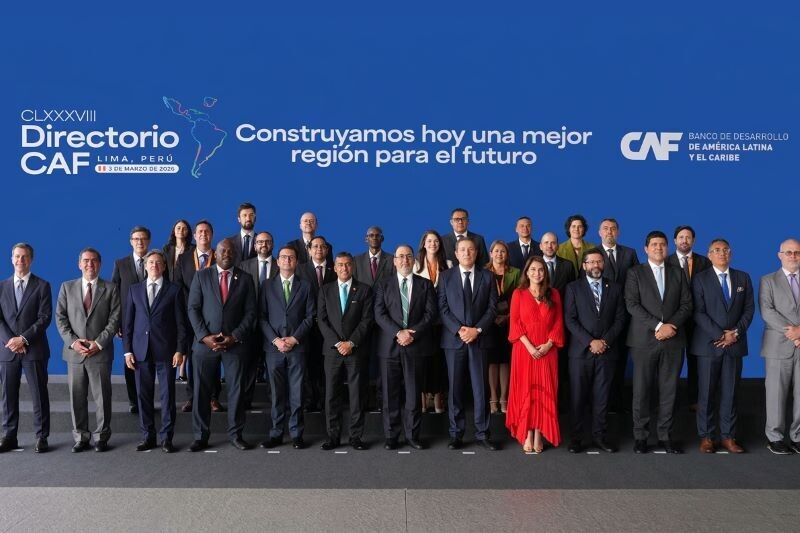
The Board of Directors of CAF -development bank of Latin America and the Caribbean- approved a package of financial resources totaling USD 1.130 billion. These funds are intended to drive sustainable development through projects that improve climate resilience, water security, emergency management, and fiscal balance in various member countries.
CAF's approval breaks down into four fundamental axes. In Spain, a USD 230 million credit was approved for the company ACOSOL to guarantee water security in 11 municipalities on the Costa del Sol. In Uruguay, a credit line of USD 450 million was established to strengthen debt management and response to climate contingencies. Ecuador will receive USD 450 million distributed in two operations focused on reinforcing public security and disaster response capacity. Additionally, the bank presented a comprehensive strategy to turn Peru into a global leader in tourism.
Sergio Díaz-Granados, executive president of the institution, highlighted that these resources reaffirm the bank's position as a strategic partner, offering concrete solutions to the most pressing challenges of the populations. He also underlined that the expansion into the Caribbean, with the start of the process of incorporating Saint Vincent and the Grenadines as a shareholder, positions the entity to become the development bank with the greatest geographic coverage in the region.
During the session, it was announced that the presidency of the Board will be transferred to Uruguay. Uruguay's Minister of Finance, Gabriel Oddone, will hold this mandate for one year, starting April 1, 2026, succeeding the Minister of Finance of Trinidad and Tobago, Davendranath Tancoo.
Another relevant milestone was the presentation of the institution's Transparency Report. During 2025, the bank significantly expanded the dissemination of its institutional indicators, increasing them from four to over thirty metrics, including data on financing, Sustainable Development Goals (SDGs), and operational information.