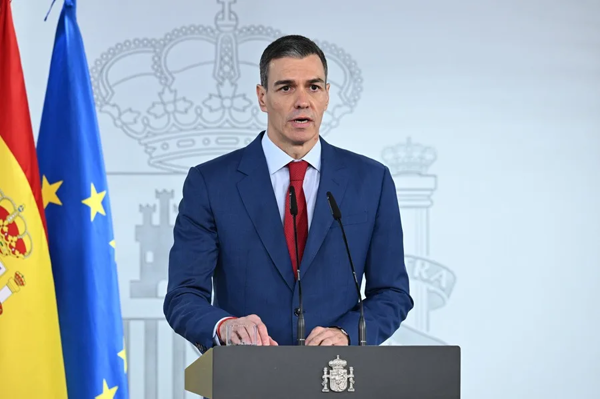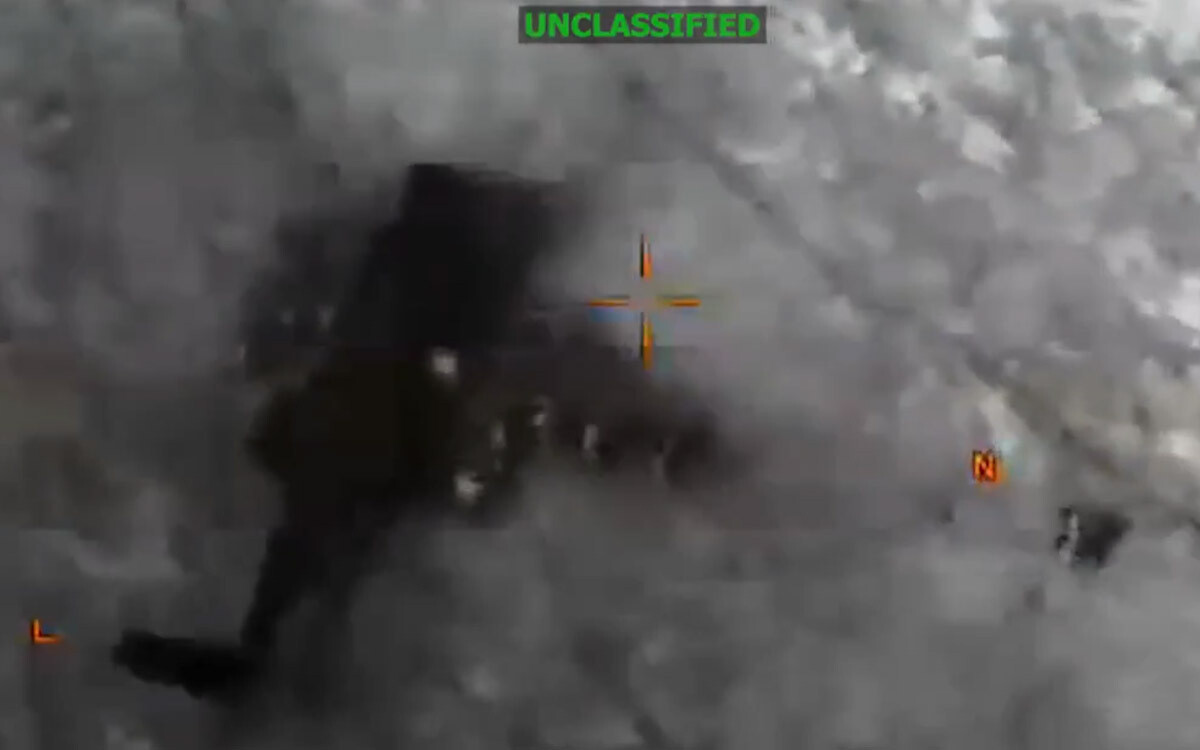
The President of Spain, Pedro Sánchez, spoke today at the La Moncloa Palace, assuring that the Spanish government's position on the armed conflict in the Middle East, caused by attacks from the U.S. and Israel against Iran, is summarized as 'No to the war,' alluding to the phrase that led the protests against the Iraq war in 2003. The journalist Manuel de Santiago reported that during his message, the head of state recalled that the U.S. 'dragged Spain' into the war in Iraq in 2023, with the justification of the supposed existence of weapons of mass destruction. Sánchez said that that war triggered an increase in jihadist terrorism, in clear reference to the March 11, 2004 attacks, with the explosion of four bombs in trains approaching Madrid, which left 192 dead. He also warned that Spain will not be 'an accomplice of something bad for the world' as the current war in the Middle East 'only out of fear of retaliation from someone,' in reference to the threats of the President of the United States, Donald Trump, to cut trade with the country for its position on the conflict. At the same time, he noted that attacks on military supply points have been intensified to further limit Iran's offensive capability. Sánchez also ordered to increase surveillance in France, reported on repatriation flights, and mentioned controls to avoid unjustified increases in the price of fuel. Journalist Jesús Esquivel reported on the press conference offered at the Pentagon by the U.S. Secretary of War, Pete Hegseth, and the general Dan Caine, chairman of the Joint Chiefs of Staff, in the context of the conflict with Iran. The Secretary of War stated that in four days the United States has managed to 'almost disable Iran's ability to launch missiles.' He added that he recognized that Tehran continues to carry out 'sporadic attacks here and there,' although he maintained that these are directed 'basically at points where civilians are.' In that same message, the U.S. official warned: 'We are going to pursue, locate, and kill Iranian leaders and eventually we are going to control Iran.' He also reported that in recent military movements, U.S. forces destroyed an Iranian warship, leaving that country practically without a navy. In turn, General Caine announced that the Central Command, responsible for the operations, will soon initiate actions on land, although he specified that 'they will be tactical.' He did not detail if this will involve the deployment of U.S. troops on Iranian soil. Oscar Ocampo, director of Economic Development at IMCO, explained why there is usually an overreaction and what role the Persian Gulf and the Strait of Hormuz play in the perception of risk. Ocampo detailed the rebound of more than 15% of the Brent Crude Oil Price (Europe) and contrasted it with the reference in the United States; furthermore, he landed the impact in Mexico: the Mexican mix and the differential compared to the price expected in the economic package. He warned of the 'double effect' for the country: potential higher income from crude, but pressure from higher fuel costs, with implications for fiscal stimuli and the commitment to keep regular gasoline at 24 pesos per liter. President Emmanuel Macron sends aircraft carrier to the Mediterranean due to crisis in the Strait of Hormuz. France deploys military means amid the escalation in the Middle East. From Paris, Florencia Ángeles reported that President Emmanuel Macron announced the sending of the Charles de Gaulle aircraft carrier to the Mediterranean Sea and proposed forming a coalition to 'resume and secure' traffic on key maritime routes, with emphasis on the Strait of Hormuz, through which approximately 20% of the world's oil and liquefied natural gas passes, as he said. In his message, Macron pointed out economic impacts due to oil and gas prices, called on Hezbollah to cease its attacks, and asked Israel to avoid a ground incursion in Lebanon.