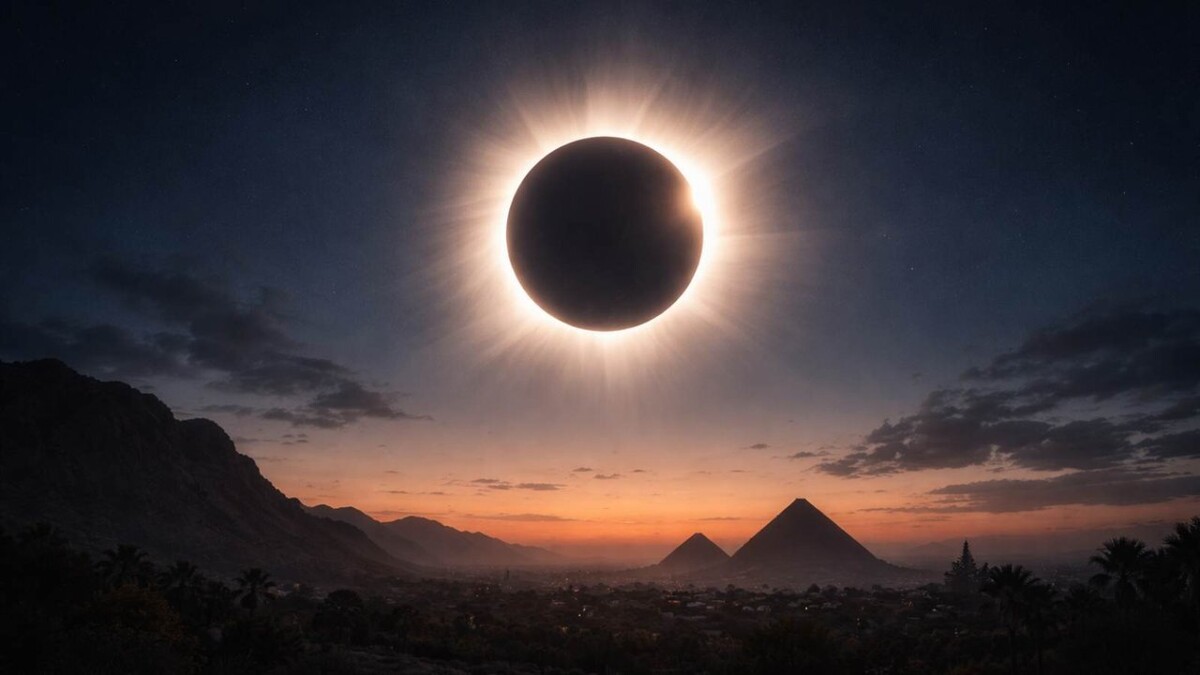
It will not be a cloud or a storm: it will be a total blackout in broad daylight, visible to the naked eye only within a very precise strip of the planet. According to the Argentine News Agency, this moment will last a little over six minutes, a very rare event in the recent history of astronomical observation from the Earth's surface. This extraordinary phenomenon will occur on August 2, 2027, when the longest total solar eclipse of the century visible from accessible areas of the planet will take place. The strip of darkness will cross Southern Europe, North Africa, and the Middle East, passing through cities such as Málaga, Cádiz, Tangier, Luxor, Jeddah, and Mecca, where millions of people will be able to watch as day turns into night for six minutes and 23 seconds. The total solar eclipse will be visible in several parts of the world. Although the event will be visible in a wide region of the northern hemisphere, it cannot be observed from Argentina, so those who wish to witness totality will have to travel to one of the countries located along its main path. This is an eclipse especially awaited by scientists and enthusiasts because its duration approaches the maximum physical possible for this type of phenomenon and because it will cross densely populated regions, something uncommon in such prolonged eclipses. Why it will be one of the most important eclipses of the century. The point of maximum duration will be recorded near Luxor, Egypt, where totality will reach six minutes and 23 seconds, an exceptional figure for solar eclipses observable from solid ground this century. During that brief period, it will be possible to observe the solar corona—the outermost layer of the Sun's atmosphere—as well as bright stars and even some planets visible in broad daylight, something that only happens during total eclipses. In addition to the visual impact, the phenomenon usually causes temporary drops in temperature and an unusual environmental sensation, comparable to a sudden dusk, making it a unique experience that millions of people are already planning to watch live.