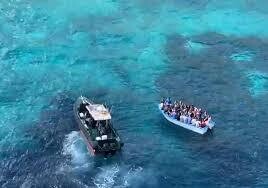
Palma de Mallorca, November 13, 2025 – A new episode reflecting the growing wave of migration towards the Balearic archipelago's coast was recorded this Thursday when the Guardia Civil and Maritime Rescue managed to save 29 people traveling on a vessel located about 19 nautical miles east of the island of Cabrera.
All rescued individuals are of Maghrebi origin. With this operation, the total number of immigrants arriving at the archipelago since Tuesday rises to 359 in just three days. The rescue operation, which took place without serious incidents, found the people showing clear signs of fatigue and prolonged exposure to the sea, according to rescue teams.
The group, composed exclusively of adults of Maghrebi origin according to official sources, was located and transferred to a port in the archipelago to undergo the corresponding reception protocol, humanitarian aid, and identification process.
The magnitude of the phenomenon is concerning for local and national authorities. The operation on Thursday unfolded without serious incidents, although the rescued showed clear signs of fatigue and prolonged exposure to the sea. This rescue is part of a context in which, in just a few days, various boats have arrived in different areas of the Balearics, putting the care system and security forces in the region under high demand.
From a migration policy perspective, this places the Balearics as a crossroads for routes that have been less visible than those leading to the Canary Islands or the Strait of Gibraltar. Meanwhile, local and national governments face the challenge of combining border management, humanitarian rescue, and integration policies with often limited resources amidst a migration wave that shows no signs of abating.
The need for maritime dissuasion policies and joint action with North Africa to curb the irregular flow is also being considered. The rescue of the vessel 19 miles east of Cabrera also serves as an indicator of the effectiveness of Spanish maritime surveillance devices, although it raises questions about prevention at early stages of the journey.
At the same time, non-governmental organizations and humanitarian groups warn that despite rescue operations, situations of irregular transit with serious consequences persist. The volume of 359 people in just a few days in the Balearics also has significant logistical implications. Ports equipped to receive migrants, immediate medical care services, temporary shelters, and management personnel are already under increasing pressure.
The rescued individuals demand international protection and access to the asylum system, while the debate on irregular migration intensifies in Spain and Europe. The central government must coordinate with the Autonomous Community to reinforce rescue devices, expand reception resources, and analyze new ways to manage the migration flow.
Maritime Rescue and the Guardia Civil maintain patrols and coordination with air assets, but the rescued manage to approach the archipelago significantly before being detected, which reveals an operational margin that could be improved. Finally, the incident has a human and political dimension. In this sense, the archipelago appeals to the solidarity of other autonomous communities and to the strengthening of resettlement or internal transfer mechanisms to alleviate the burden.
Faced with this reality, the Government Delegation warns of the "growing intensity" of the flow and demands the collaboration of other European states in sharing responsibility. The reported scenario once again highlights the vulnerability of migrants undertaking dangerous journeys in precarious boats. The conditions in which many of these boats are found—whether in high seas or near coasts—complicate rescue operations and multiply the risks of shipwreck or loss of life.
The sighting occurred around 11:40 a.m., as reported by the Government Delegation in the Balearics in an official statement.