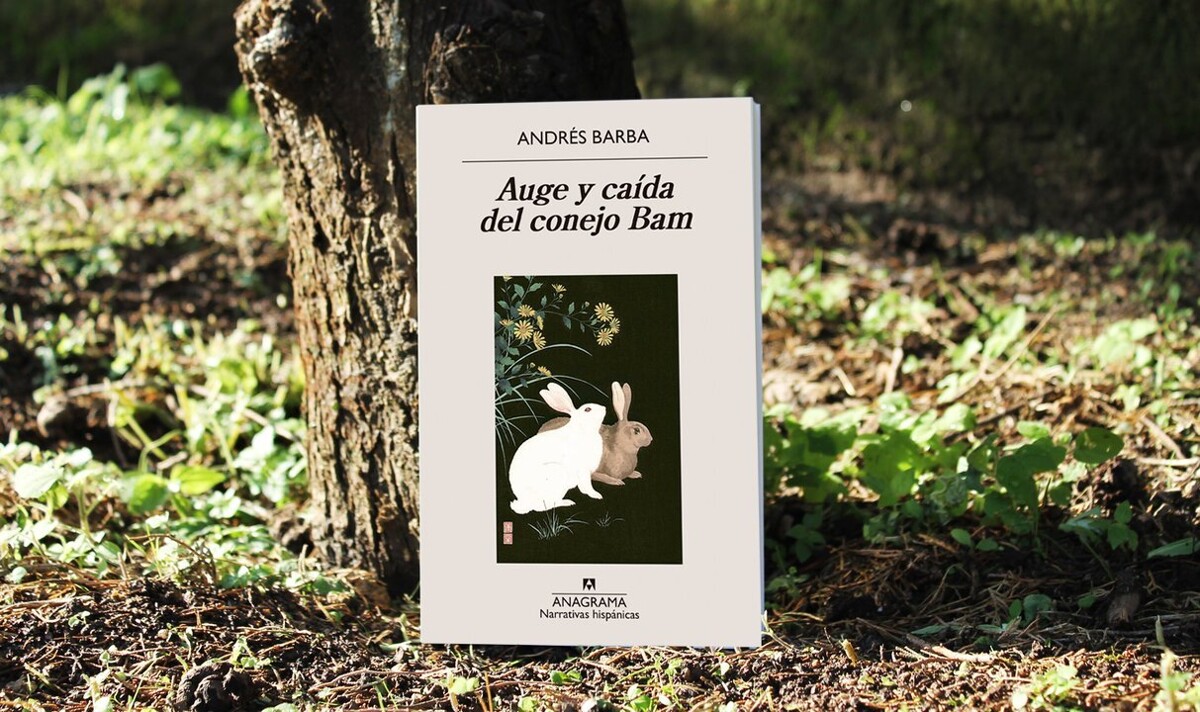
In this movement, Barba creates a fable that bears far less resemblance to a children's tale than to a mechanism for thinking with ease about contemporary politics. The burrow is a metaphorical laboratory. And this is no accident: Barba has always worked with uncomfortable narrators, characters who observe reality from a displaced angle, never entirely reliable but deeply human, even when they are animals. The relationship between Copito and Bam articulates two opposing forces: on the one hand, the construction of a myth, and on the other, the need to dismantle it. In it, we see the rabbits discover their collective identity, organize incipient institutions, create rituals to sustain them, place their hopes in a seemingly providential leader, fall into conflict, fear for their safety, aspire to freedom, and finally, face collapse. This structure responds to a deliberately ambitious design. From Orwell, it takes the emotional charge, but it moves away from the allegorical mechanism that turns the text into a game of immediate interpretation. 'The Rise and Fall of Rabbit Bam' does not invite the reader to seek historical equivalences or unmask figures from the real world. One of the most interesting paradoxes of the book is that the author, who has lived in Argentina for years with his wife and children, claims to have written this novel as an act of 'liberation'. He wanted to escape, for a moment, from the human world; to get out of the routine of the present, of urgent debates, of the pressure to interpret the present. Because the distance of the fable allows him not to fall into the temptation of correcting reality or passing moral judgments. The novel thinks without indoctrinating, observes without offering recipes. And it is political not for what it denounces, but for what it illuminates. In the end, 'The Rise and Fall of Rabbit Bam' is, in appearance, a fable about rabbits. What breaks when an adored figure is revisited from the fragility of memory? And yet, in that attempt at escape, he found the most direct way to talk about politics. Why? To think about that question in his latest novel, Barba decided to radically abandon human territory: he chooses a rabbit burrow, an animal universe with its own rules, and from there he builds one of the most singular (and, paradoxically, most political) works of his career. The novel is narrated by Copito, a discreet rabbit who has been chosen to write the story of Bam, his former companion and now a legend of the Great Burrow. That intimate ambiguity sustains the rhythm of the book. With 'The Rise and Fall of Rabbit Bam' (Anagrama), Andrés Barba once again demonstrates that his literature never settles: each of his books seems to be born from a different concern, a different discomfort. The novel never completely answers those questions; rather, it makes them vibrate. Because what happens in the burrow is not a mirror of the present, but a way to capture the deep tensions that run through our societies: the loss of trust in institutions, the fragility of community life, the anxiety before uncertainty, and the sometimes desperate need to feel protected. And yes, every time a writer turns to animals to talk about politics, the shadow of 'Animal Farm' seems inevitable. In that tension, the very dignity of the community is at play. A primitive community and a complex society. Copito oscillates between duty and guilt: he does not know if telling Bam's life story will be an act of love or a definitive betrayal. But it is also a book about the power of stories: about the responsibility of the narrator and the risk of the believer. But Copito intuits that the truth is never so pure; that every collective epic hides contradictory versions, omissions, murky zones. What happens when historical memory depends on a single narrator, with their fears and affections? Behind that friendly surface, a dense, sophisticated, and at times disturbing narrative unfolds. Barba constructs a novel that can be read as an epic adventure, a political meditation, a philosophical essay, or an intimate tragedy between two creatures who loved each other and did not know what to do with that loyalty. It is a novel about how communities are born, grow, and collapse; about how we need heroes to sustain our hopes, and how those heroes inevitably fail us. All of them share the same obsession: to understand how a social bond is formed, sustained, and broken. In the burrow, Bam is a hero, a leader, a savior. Barba dialogues with Orwell, but with very marked nuances. The author has said that he conceives of the novel as a complete historical cycle, almost Hegelian, but it is not a disguised philosophical manual; it is a living story, full of intense scenes and, above all, of questions that resonate far beyond the fiction.