Spanish researchers have developed a hybrid device that allows capturing energy from both the sun and rain simultaneously. According to the Argentine News Agency, the new device consists of a thin sheet that not only protects and improves the durability of perovskite solar cells, even in adverse weather conditions, but also allows nanogenerators to produce over 100 volts from the impact of a single drop of water, enough to power small portable devices. The research team belongs to the Institute of Materials Science of Seville (ICMS), a joint center of the Spanish National Research Council (CSIC) and the University of Seville (US).
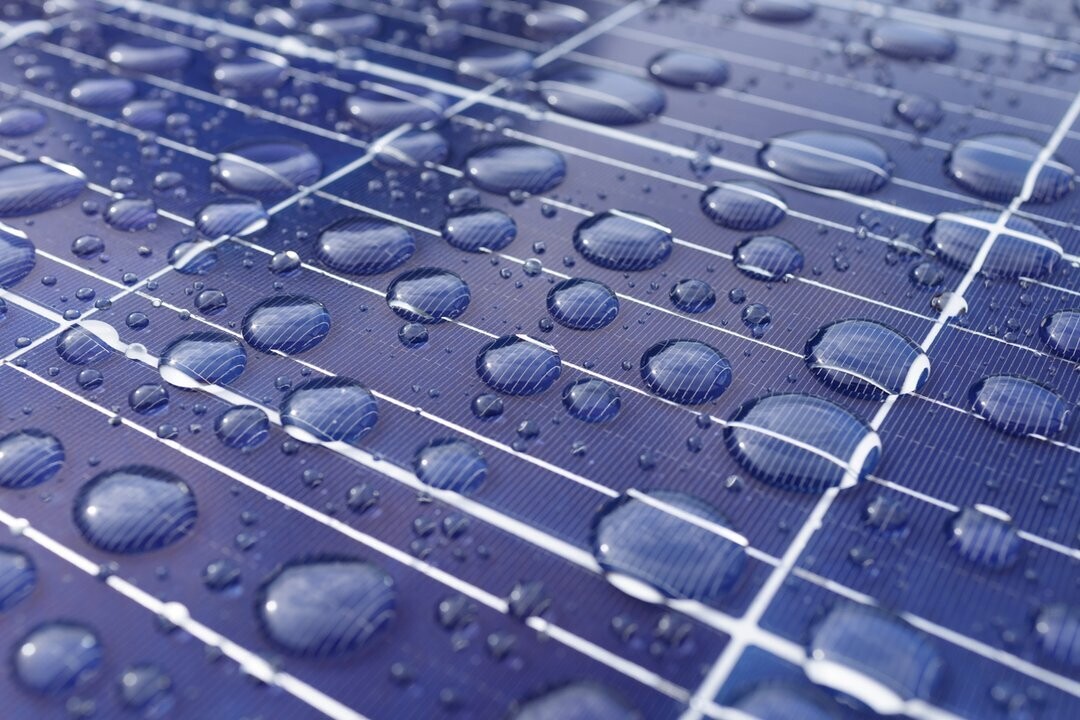
How the new material works. From CSIC, they explain that halide perovskite solar cells are photovoltaic devices composed of synthetic materials with a crystalline structure and excellent light absorption properties. Although silicon technology is the most widely used, perovskite technology has great potential to revolutionize photovoltaic energy due to its high efficiency and low cost. On one hand, this system acts as an encapsulant that chemically protects the perovskite cells and optically improves their ability to absorb light; and on the other hand, it has a surface that converts the kinetic energy of raindrops into electric current.
The new material can generate up to 110 volts with the impact of a single raindrop, enough to power a small portable device. The goal of this development is to provide energy autonomy to portable and wireless electronic devices and to allow their continuous operation in both sunny and rainy conditions. However, their degradation or instability in environmental conditions is one of their main drawbacks. For this reason, the researchers used plasma technology to create and deposit a protective sheet of about 100 nanometers on the solar cells. The authors highlight that the developed device is an important innovation for the entire Internet of Things (IoT) industry, such as environmental sensors (humidity, rain, pollution), structural sensors (bridges, buildings), weather stations, or precision agriculture.