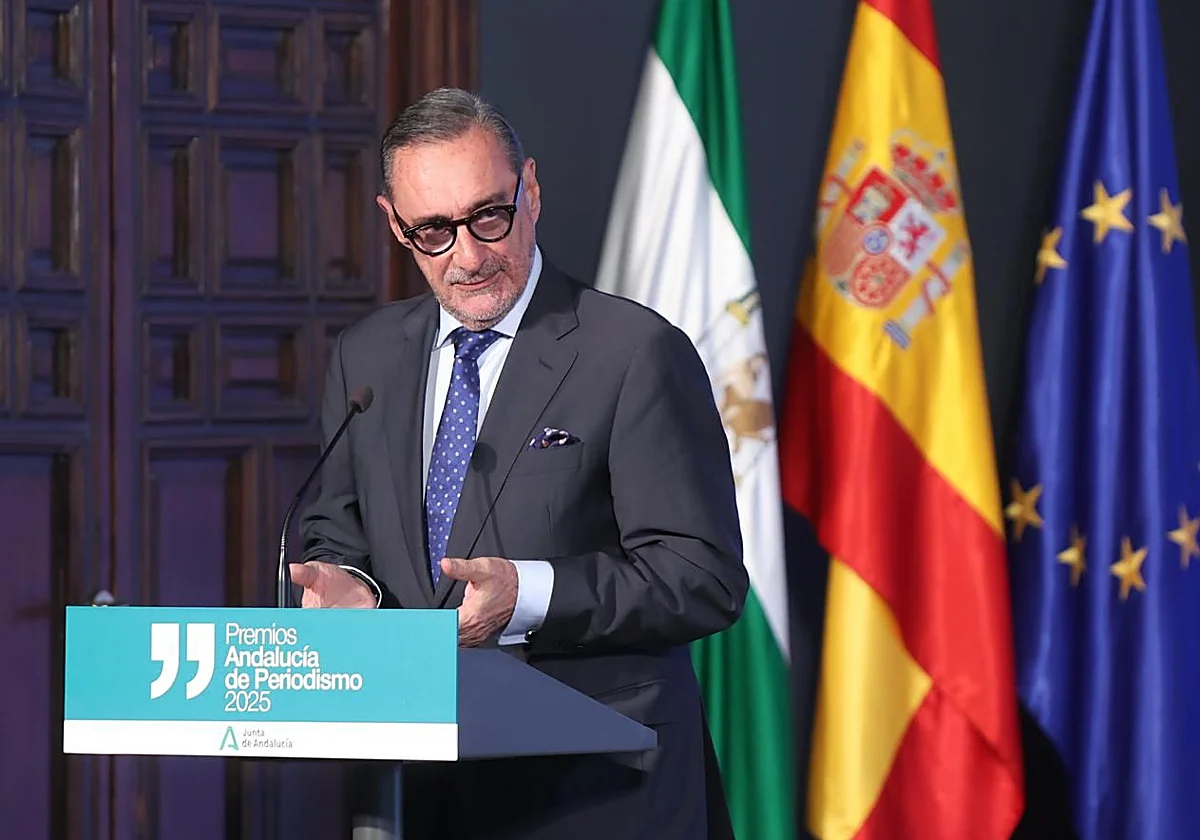
Journalist Carlos Herrera has been awarded the Andalusia Journalism Prize for his professional career this Friday, presented by the president of the regional government, Juanma Moreno.
“Fifty years after starting at Radio Sevilla on González Abreu street, I still get emotional when the red light in the announcer's booth goes on. It's actually a door to the unknown,” he added.
Herrera expressed his happiness that “a jury of incorruptible men and women” felt he had enough years of service to receive a lifetime achievement award. “I would have preferred the award for best newcomer, of course, but almost 50 years in the trade speak for themselves,” the Almería-born journalist stated, pointing out that he has been in radio “for longer than the step of a pyramid.”
According to Herrera, Andalusia “has long left its historical defeatism, happily shaking off stereotypes, and the so-called curses no longer hold any weight.”
During the event, held at the Palacio de San Telmo, he mentioned that he still likes “a small, dimly lit studio, perhaps with a little window onto the street and the technician's face nearby to see if he can manage my impossible gestures.”
“I have always asked for divine forgiveness for living in Andalusia through thick and thin; for paying what Master Burgos called the 'IVA'—the tax for living in Andalusia,'” he pointed out.
His morning show on COPE, a leader in radio ratings, is broadcast mainly from Sevilla and sometimes from Sanlúcar de Barrameda, where the immense avenue that is the Guadalquivir River ends.
The master began his speech with a joke.
“I have been lucky enough to meet more good people than bad ones,” he said.
Beyond his humor, he praised the talent of Andalusia, “which should aspire to lead Spain.”
Moreover, he had to leave the event midway and missed the president's speech.
In addition, he has been recognized with the Medal of Andalusia, the Medal of the Provincial Council of Sevilla, and has been the official herald for the Holy Week in Sevilla and the Carnival in Cádiz.
Among his numerous books are 'Carmen Sevilla: memories,' several books about the real, emotion-filled experiences he recounts in his 'fósforos' (short anecdotes), and others like 'La cocina de Carlos Herrera' (The Cuisine of Carlos Herrera), 'Tapas,' or 'Mis recetas favoritas' (My Favorite Recipes), which deal with gastronomy.
The Professional Career Award, created in 2021, is being given for the fifth time, after previous editions were awarded to Andalusian journalists María Teresa Campos (2021), Paco Lobatón (2022), Antonio Burgos (2023), and Curri Valenzuela (2024).
Source: ABC
Herrera, born in Cuevas de Almanzora (Almería), has defended his homeland from his communicative pulpit.
“I have known masters of the craft, unlucky types, others uninspired and insignificant, others whose mere clearing of the throat was a recital; I have spent hours in unsanitary newsrooms, with whisky and tobacco everywhere, with prehistoric machinery that none of those fortunate enough to accompany me today would know how to use,” added Carlos Herrera, who has directed the morning news program 'Herrera en COPE' since 2015.
Herrera concluded his speech with a “¡Viva el Betis!” (Long live Betis!).
From Sevilla to All of Spain
Carlos Herrera, journalist, radio host, and television presenter, has directed the morning news program 'Herrera en COPE' since 2015, which is broadcast from Sevilla to all of Spain and has been the leader in its time slot in Andalusia for several years.
He recalled his colleagues' comments when he said he was broadcasting from Andalusia: “You've got it made,” to which he would reply that “it has been scientifically proven that the program from Sevilla lasts exactly the same as one made from Madrid.”
“Another thing is that when I leave the radio, my feet are in the city of my life. The place everyone wants to come to, where many arrive daily in search of their promised land, and not just for the guaranteed heating,” he declared.
“It is the community with the greatest potential in Spain,” he added.
“What an original way to start,” he joked.
Herrera gave a short speech because he had to leave due to professional commitments.
With this joke, he wanted to reclaim, without needing to emphasize it, the importance of human communication, which reaches its highest expression in journalism.
On March 27, 2000, during his time as an announcer at Radio Nacional de España, he received a fake box of cigars, a package bomb that failed to explode, although he did open it in an elevator.
The attack, claimed by the terrorist group ETA, led him to make a decision to protect his family: emigrate to the United States, which saved his life, as in the second ETA assassination attempt, he was residing in Miami.
Honorary Doctor by the European University (2021) for his contribution to the profession and society through Journalism, he has received numerous recognitions such as six Ondas Awards, three Antenas de Oro, the Mariano de Cavia, the Joaquín Romero Murube, the Víctor de la Serna, and the Micrófono de Oro, among others.
Previously, he took his radio formula to Onda Cero –from 2004 to 2015– and directed and presented programs on Canal Sur Radio, Cadena Ser, Radio Nacional de España, Radio Popular, or Radio Miramar de Barcelona.
He started on the radio at Radio Sevilla and Radio Mataró, and debuted on television in 1985, first presenting the TVE Telediario, and later musical programs such as 'Sábado noche' (TVE) or 'Las coplas' (Canal Sur Televisión).
In 'Primero izquierda' (1991-1992, TVE), he interviewed world-renowned figures such as British Prime Minister Margaret Thatcher, actresses Catherine Deneuve and Ursula Andress, and singers like Diana Ross.
A graduate in Medicine, a profession he never practiced, he has been a regular contributor to written media such as 'Blanco y Negro', 'XL Semanal', or 'Diez Minutos'.