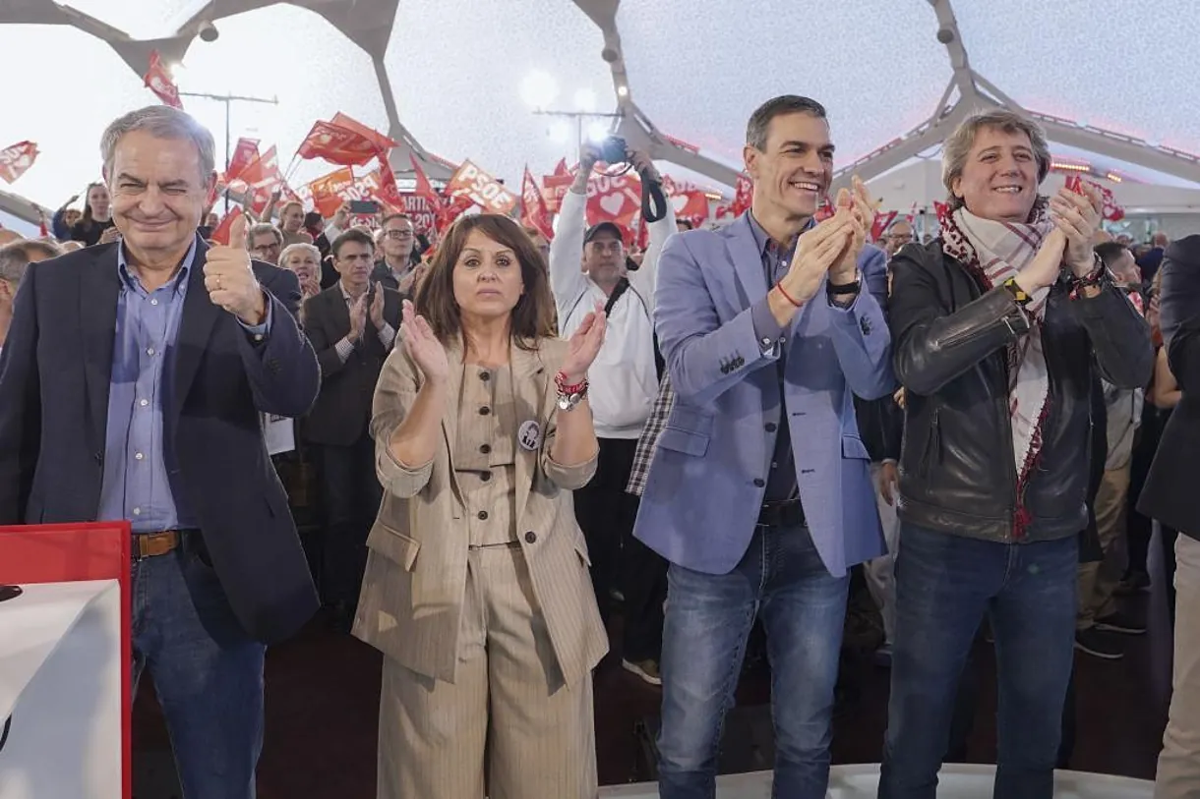
The joint presence of the Prime Minister, Pedro Sánchez, and former Prime Minister José Luis Rodríguez Zapatero transformed the rally in Valladolid into a political reclamation of the historic 'No to the war,' now used as a mobilization tool for the left and as a direct contrast with the Spanish right and the legacy of José María Aznar. In this context, Sánchez insisted that an overwhelming majority of Spaniards do not want war and publicly thanked Zapatero for his 'courage,' linking that 2004 decision to withdraw troops from Iraq with the current government's stance. Zapatero, in turn, deepened this line and once again presented the withdrawal of Spanish troops from the Iraqi scenario as one of the most defining decisions of his mandate. The minister's intervention further nationalized the campaign closure, which at times seemed less focused on the regional dispute with Alfonso Fernández Mañueco and more on the ideological battle of Spanish socialism against the right. Carlos Martínez, for his part, tried to shift the focus back to the land of Castile and León, criticizing the nearly 40 years of PP governments, the neglect of the community, and the denial of machista violence, which he attributed to Vox. However, the weight of Sánchez and Zapatero ultimately imposed a national reading of the event. Ultimately, the PSOE decided to squeeze every last minute out of a historic flag it considers mobilizing and morally profitable: the flag of rejection of war. The socialist candidate, Carlos Martínez, was accompanied by a scene of high national density, in which Minister Óscar Puente also played a leading role. The central message was clear: while, according to the socialist narrative, Spain reclaims peace, the right once again looks to Aznar and to the political photograph of the Iraq War. Sánchez recovered this memory by recalling Zapatero's opposition to the 2003 intervention and connected it with his current rejection of an action that socialism considers illegal against Iran. 'No to the war' thus reappeared as a slogan of identity, but also as a campaign tool, at a time when the conflict with Iran and the role of Donald Trump are once again crossing the Spanish political debate. In a campaign marked by the advance of the PP and the growth of Vox, the socialists chose to sharpen the ideological contrast to try to activate their most faithful electorate. With this line, the head of government sought to position the PSOE as heir to a tradition of resistance against military adventures promoted by the United States, while trying to turn that position into a factor of electoral mobilization for the regional elections on Sunday. The appeal was not accidental. The organization highlighted a strong turnout, with thousands of people inside and outside the venue, in an image that the ruling forces wanted to read as a sign of enthusiasm in the final stretch of a difficult campaign for the PSOE in a community where the PP has been hegemonic for decades. In this climate, Óscar Puente contributed the most combative and personalist tone. The former leader also took the opportunity to praise the current government for other measures, including the regularization of immigrants and the Democratic Memory Law, in an exchange of mutual recognitions that reinforced the image of continuity between both leaderships. The event was held at the Millennium Dome in Valladolid, a place full of symbolism for the 'sanchismo,' as it was the site of one of the decisive moments in his internal comeback in the socialist primaries of 2017. It remains to be seen if this resource will be enough to turn an elusive trend around or, as previous polls suggest, the message serves more to order the progressive electorate than to alter the power map in Castile and León. He hailed Sánchez as a leader forged in adversity, said he was able to stand up to a 'bully,' in an allusion to Trump, and ended up pushing the 'No to the war' slogan before an audience clearly aligned with that message. The PSOE's campaign closure in Castile and León this Friday became much more than a regional electoral act. His intervention had an autobiographical tone, with references to the call he received from George Bush and the political difficulty of that determination. This move seeks to unite memory, identity, and international current affairs to reactivate its base in an adverse community. But it also functioned as explicit support for Sánchez, placing him in the same tradition of resistance against a military action that considers it illegal. He also defended a '100% feminist' project and called for mobilization against the accumulated fatigue in a region battered by depopulation, the lack of structural responses, and the wear and tear of a very long political continuity.