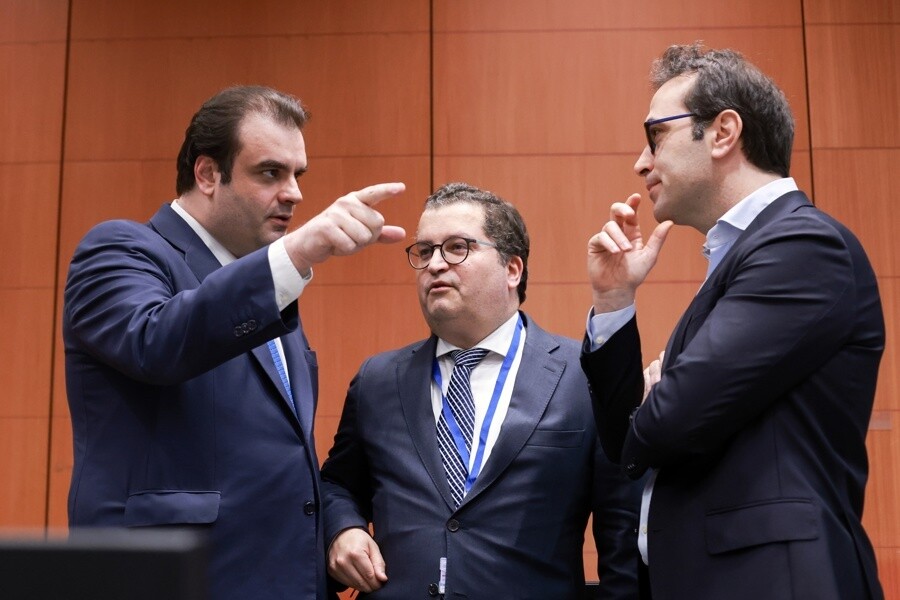
The Spanish Minister of Economy, Trade and Enterprise, Carlos Cuerpo, highlighted that the economic effect of the war is already being felt in the pockets of Spaniards due to the rise in gasoline and diesel prices and assured that the Government will act to protect citizens and companies depending on how events unfold. "We have clear which are the measures that can be applied and we are going to be putting them on the table as the situation develops," said Cuerpo, who also pointed out that they have the experience from the war in Ukraine. His Irish counterpart, Simon Harris, advocated for taking measures "step by step" since "it is difficult to predict if (this conflict) is going to last days, weeks or months" and "a very different response" is required depending on which scenario materializes. "We have to be very careful that the medicine we administer is the correct one," he said. In response to the crisis caused by the war in Ukraine, which pushed eurozone inflation above 10%, Brussels gave flexibility to member states to approve public aid, from direct subsidies to tax cuts and corporate credit lines. Internationally, one of the measures carried out in 2022 was the release of strategic oil reserves to soften the price increase, something the G7 has put back on the table this Monday. The French Minister of Finance, Roland Lescure, whose country currently holds the rotating presidency of this forum, convened a telematic meeting of the G7 before the Eurogroup meeting, after which he reported that they are willing to adopt "all necessary measures" to stabilize hydrocarbon markets. "We leave the option of releasing national oil reserves open. The Ministers of Economy of the eurozone (Eurogroup) are preparing to take measures against the economic impact of the war in the Middle East inspired by those adopted during the energy crisis derived from the war in Ukraine, four years ago, although with caution due to the uncertainty about the duration and breadth of the conflict. "We are open to discussing measures depending on how the crisis manifests in the coming weeks. We are following the situation and are also aware that it is necessary to adjust and adapt these tools," said the president of the Eurogroup, Kyriakos Pierrakakis. European ministers addressed this Monday the possible economic impact of the war unleashed by the attacks of the United States and Israel on Iran and Tehran's retaliation against Persian Gulf countries, which has driven up crude and gas prices and paralyzed maritime traffic through the Strait of Hormuz. Partners agree that it is necessary to closely monitor an extremely uncertain and volatile situation and anticipate that the impact on the European economy will be greater the longer the conflict lasts. We have a toolbox that we used (...) in 2022 with the invasion of Russia to Ukraine, but we are not there yet. If it prolongs, it will lead to an increase in inflation motivated by the rise in energy prices and a low economic activity, explained the European Commissioner for Economy, Valdis Dombrovskis. "That is why it is important to de-escalate the conflict as soon as possible." The last time was precisely in 2022, when a total of 180 million barrels were put on the market to guarantee supply after Russia's aggression against Ukraine. The other three times were in 1991, in the midst of the Persian Gulf War; in 2005 due to the effects of hurricanes Katrina and Rita in the United States, and in 2011 as a consequence of the civil war in Libya. The week began with another new rise in the price of the Brent barrel, the benchmark in Europe, to exceed $118, although it lost momentum as the hours passed to settle around $100. The Eurogroup, ready to dust off its arsenal against the energy crisis caused by the war in Iran. It is not the right time for this yet, but we are open, including Germany, to launching a coordinated procedure at the right time," said his German counterpart, Lars Klingbeil. The release of strategic crude oil reserves in coordination with the International Energy Agency (IEA) is one of the possible lines of action cited by Dombrovskis and is also supported by the Spanish Minister of Economy. Since its creation in 1973, the IEA has coordinated the release of stored oil on four occasions to tackle episodes of sharp increases in crude oil prices.