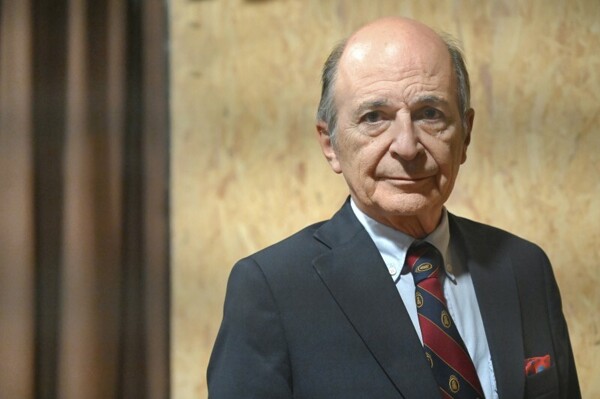
Despite her attempt to distance herself from the government, she turned her intervention into a defense of the laws of Minister Bolaños, both the one that gives instructions to prosecutors, taking it away from judges, and the reform of the Fiscal Statute, which, according to the prosecutors themselves, does not sufficiently shield their autonomy. She criticized the new Attorney General for the fact that the unit of action and hierarchical dependence that govern the Prosecutor's Office's actions have served to 'unjustifiably sow doubts'. The new Attorney General, who is expected to take office next week, recognized the work of her predecessors, also that of her predecessor, whom she only alluded to to refer to the 'deep wound' that this criminal proceeding has caused in the Prosecutor's Office and that she hopes to heal 'with the work of the 2,804 prosecutors' who are part of the institution. Álvaro García Ortiz's successor at the head of the State Attorney General's Office, Teresa Peramato, rejected this Thursday publicly condemning the attacks from the Government and her own association, the Union of Prosecutors (UPF), on the magistrates of the Supreme Court who convicted her predecessor, Álvaro García Ortiz, for revealing reserved data. In her appearance before the Justice Commission of the Congress of Deputies, where she passed the filter for her appointment (on November 28th, the General Council of the Judiciary already declared her suitable), Peramato declined to assess the UPF's accusation of the Supreme Court for 'institutional violence', as well as that of various Government members. Whoever does this 'ignores' the work of the Attorney General's Office, she pointed out, because in the appointment of the Attorney General, it is the only one in which the three branches of the State participate: the Executive, by proposing her; the General Council of the Judiciary (CGPJ) by verifying her suitability, and the Congress of Deputies, before whom she must appear. She did so based on her 'absolute' respect for freedom of expression and on the fact that she was not going to make 'any political assessment or in relation to ongoing judicial proceedings'.

Spain's New Attorney General Defends Government's Laws
Spain's new Attorney General Teresa Peramato refused to condemn government attacks on Supreme Court justices, defending Minister Bolaños's laws. She spoke of her respect for freedom of expression and judicial independence.